The Greek taverna experience: eight details that shape your evening
 Save
A Greek taverna experience runs on a different clock from a restaurant meal. Plates arrive in waves rather than in courses, the room stays bright and loud, and nobody moves you off the table at the end. Delphi Restaurant publishes independent guides to Greek dining for readers in the UK, and the eight sections below set out what the room, the service, the food and the bill actually look like.
The room, the noise and the pace of the evening
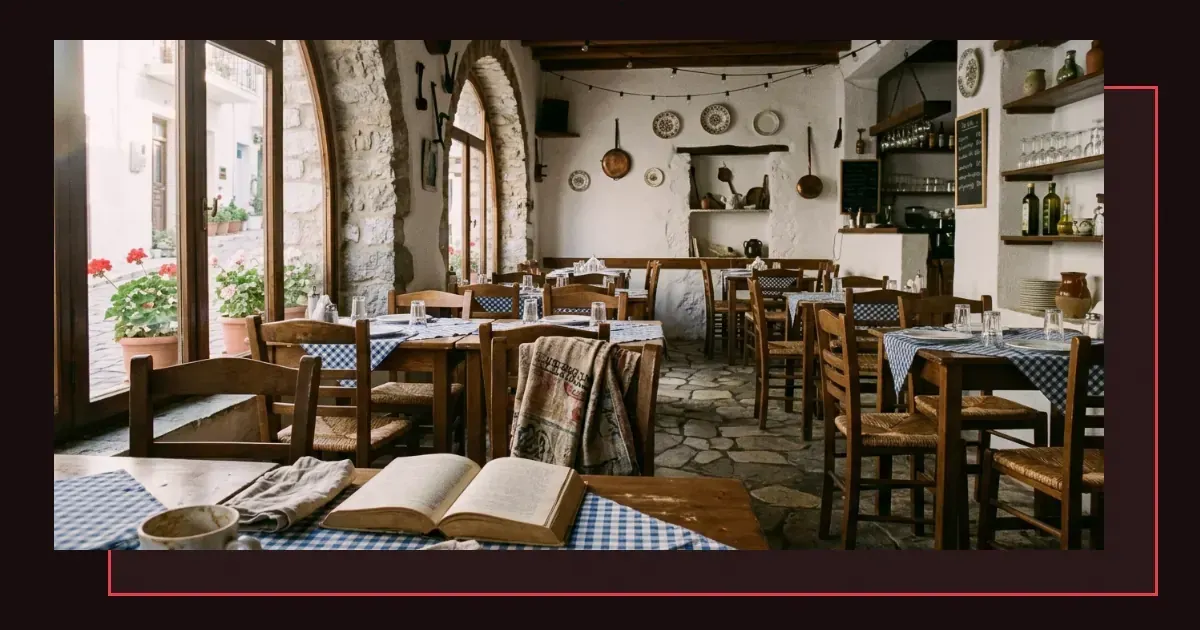
A taverna is arranged for company rather than for hush. Tables sit close, the lighting stays bright enough to read a menu across the room, and the volume rises as the tables fill. None of that is accidental: the room is built to keep a group talking.
Expect to keep your table for the evening. A taverna works on a long sitting rather than a fixed slot, which is why plates appear as the kitchen finishes them and why nobody hovers with the next booking.
Seating tells you what kind of evening is intended. Long tables pushed together, mismatched chairs and a few pavement tables facing the street all point to a room that expects people to settle in rather than turn up, eat and leave.
What a full room tells you
A full room is worth reading before you sit down. Tables filling early point to a kitchen cooking to demand, and a kitchen cooking to demand works through its stock rather than storing it.
Telling a working taverna from a themed one takes a few minutes of looking. Our guide to the signs of an authentic Greek restaurant sets out what holds up and what does not.
Service that follows the kitchen
Service in a taverna is informal and warm, and it moves with the kitchen rather than to a script. A server may bring several plates at once, take the order in a sequence you did not expect, and then leave you alone. None of it is neglect.
The consequence is that a taverna will not reliably finish you by a set time. If a train or a film is waiting, say so when you sit down and order fewer, larger plates instead of a long run of small ones.
Asking for things directly
Staff answer a plain request faster than a hint. Want the plates spaced out? Say it at the start. Want everything at once? Say that instead. A taverna is flexible enough to do either, but it will not guess.
The menu as a run of shared plates
The menu is built around meze: small dishes that land in the middle of the table and get passed around. That structure is why a taverna table fills with plates rather than with individual mains, and why ordering becomes a group decision rather than a private one.
Our guide to what meze is and how to order it covers the arithmetic of a shared table. The short version: order broadly, expect a second round, and add a dish later rather than over-ordering at the start.
- A bowl of thick yogurt or tzatziki to cool the fried plates
- Something grilled over charcoal, ordered by piece or by weight
- Beans or greens dressed simply, for contrast
- Bread, which the table will need for everything else
- One fried plate, eaten while it is still hot
Keeping a shared table moving
Fried plates do not wait. Saganaki and small pies are worth eating in the minute they leave the pan, so deal with them before turning to the salad. Grilled fish and slow-cooked dishes behave the opposite way: they hold, and they can sit while the table catches up.
Taverna and formal restaurant side by side
The same dish can arrive in two completely different evenings. A taverna and a formal restaurant are built for different kinds of time, and the comparison is easiest laid out flat.
| What you are comparing | Taverna | Formal restaurant |
|---|---|---|
| Pace of the meal | Set by the kitchen, over a long sitting | Paced to a menu and a booking slot |
| How you order | Shared plates in waves | Individual courses in sequence |
| The room | Bright, close tables, rising noise | Low light, spaced tables, quiet |
| Who leads the evening | The table | The kitchen |
| What you wear | Whatever you arrived in | A little more thought |
Neither is better, and the choice comes down to the evening you want. For a birthday with a long table and no schedule, the taverna fits. For a meal where the cooking is the whole point and conversation is secondary, a formal room does the job.
The food itself can be identical in both. What changes is the frame around it: whether you are being moved through a sequence or left to work through the table at your own speed.
Drink at a taverna table
Drink belongs to the meal rather than to the wait before it. Ouzo comes in a small glass with a jug of iced water beside it, and that water is not garnish: adding it clouds the spirit and softens the anise.
Retsina, the resinated white wine, divides the room and always has. Order a glass before committing to a bottle and let the table decide. Our piece on what ouzo is and how to drink it covers the rituals around the glass.
Water matters as much as anything else on the table. A jug sits within reach through the whole meal, and keeping it filled is the one job the table shares.
Coffee, sweets and the last half hour
The end of a taverna meal has its own shape. Plates are cleared slowly, a small glass of something sweet may appear, and coffee is ordered as a separate event rather than as a signal to leave.
Greek coffee arrives in a small cup, unfiltered, and it is drunk slowly so the grounds settle at the bottom. Ask for it without sugar if you want to taste it clearly; nobody will find that odd.
Sweets come simple and shared: a plate of fruit, a slice of syrup-soaked cake, a bowl of yogurt with honey. One plate for the table is the right instinct, and nobody expects a dessert per person.
Getting settled without a fuss
Most of the awkwardness of a first visit disappears with a short routine. Work through these in order and the evening runs itself.
- Look at the room before you accept a table, and choose one away from the door if the noise is high.
- Ask whether plates come as they are ready or whether you can set the pace.
- Order fewer dishes than there are people, then add more once the first round lands.
- Ask for small plates so that sharing is easy.
- Keep the bread and the water topped up before the fried dishes arrive.
Order for the table, not for the seat. The plates are going to be shared whether or not anyone says so out loud.
The house wine is worth saying yes to. It is poured from a jug or a barrel to be drunk with the food rather than admired on its own, and it suits a table of small plates better than a carefully chosen bottle would.
The bill, the goodbye and the tip
A taverna bill arrives when you ask for it, and it may be a handwritten slip or a figure given at the table. Check what has been counted, particularly if any plate was ordered by weight.
Tipping follows the same relaxed logic as the rest of the evening. Rounding up or leaving a modest amount is enough, and nothing about the goodbye is ceremonial. Our notes on Greek restaurant etiquette cover the smaller customs that sit around the table.
The measure of a good taverna is simple enough. You ate well, you were not rushed, and nobody at the table looked at the clock. If a place manages all three, it has done the job a taverna is meant to do.
This article is published for general information only and reflects our own reading of Greek taverna custom.
Download PDF: A first taverna visit checklist PDF, 28 KB
Further reading
Frequently asked questions
If a taverna and a restaurant serve the same dishes, what changes about the evening?
The structure of the meal changes rather than the cooking. In a taverna the plates are shared and arrive as the kitchen finishes them, and the table stays yours for the evening instead of being tied to a set sitting.
When you take a group to a traditional Greek taverna, what should you ask before you order?
Ask how the plates will arrive, and whether you can set the pace yourself. Request small plates so sharing works, then order fewer dishes than there are people and add a second round once the table has started.
What shapes the atmosphere in a Greek taverna on a busy night?
Close tables, bright light and a room built for conversation rather than hush. The noise rises as the tables fill, which is the design rather than a problem to work around.